Tanglu Linux is a fresh new distro, released for the first time this year. It's first beta release came on 19th Jan 2014 and the first final release on 22nd Feb 2014. It is based on Debian and is optimized for desktop deployment, with up-to-date software, extra drivers and regular releases. Why does it interest me and many other Linux enthusiast? Though Tanglu is not an official project of Debian but it was started with some Debian developers and meant to help Debian. Debian's annoying freezes are not there in Tanglu and Debian developers are allowed to maintain their packages in Tanglu's servers during Debian freeze. A lot more interesting stuff about Tanglu can be read in the FAQ section.
The distro promises to be semi-rolling release with major updates almost twice a year. In the first major release, Tanglu has two flavors: GNOME 3 and KDE.
I downloaded the 64-bit Tanglu 1.0 GNOME ISO for this review and created a live USB using Linux Mint Image Writer. I first did a live boot on my Asus K55VM laptop with 2.3 Ghz Core i7 processor, 8 GB RAM and 2 GB NVIDIA GeForce 630M graphics. Post live boot, I installed it on a 50 GB partition. Tanglu 1.0 ships with GNOME 3.10.1 desktop environment and Linux kernel 3.12.1. In rest of the article I discuss my experience with Tanglu for about a week.
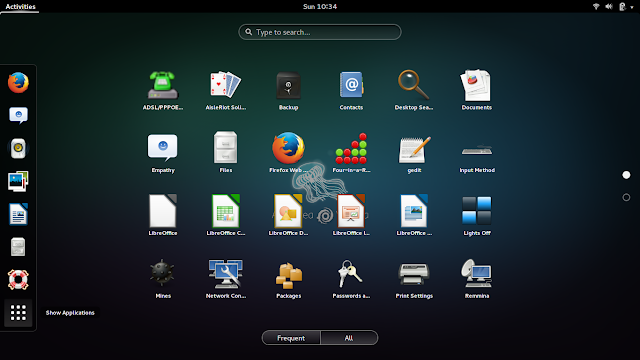 |
| From Tanglu 1.0 http://mylinuxexplore.blogspot.in |
I downloaded the 64-bit Tanglu 1.0 GNOME ISO for this review and created a live USB using Linux Mint Image Writer. I first did a live boot on my Asus K55VM laptop with 2.3 Ghz Core i7 processor, 8 GB RAM and 2 GB NVIDIA GeForce 630M graphics. Post live boot, I installed it on a 50 GB partition. Tanglu 1.0 ships with GNOME 3.10.1 desktop environment and Linux kernel 3.12.1. In rest of the article I discuss my experience with Tanglu for about a week.
Read more!
